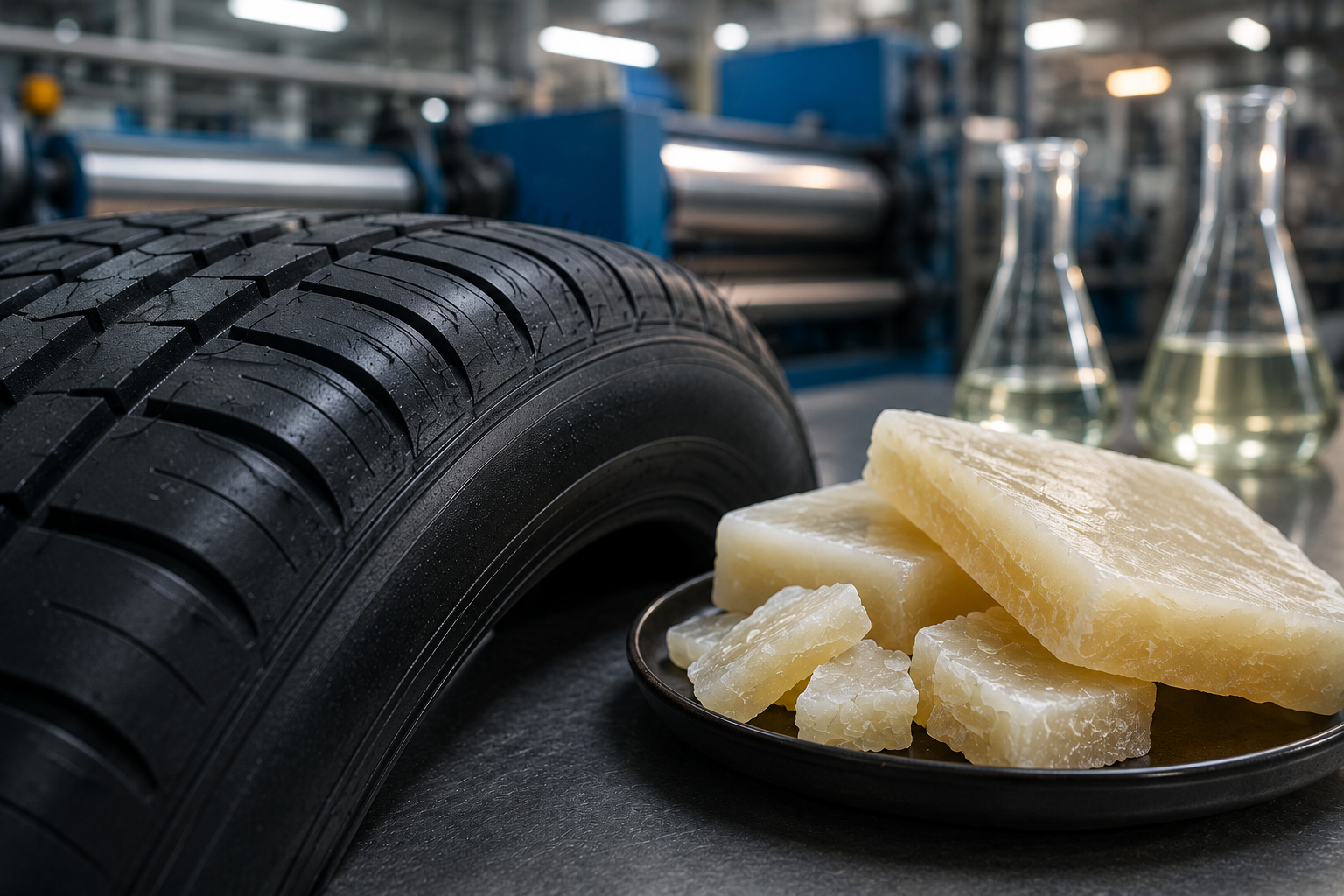
Rubber and elastomer products are exposed not only to mechanical stress throughout their service life, but also to environmental influences. One of these influences is ozone. Ozone can cause surface cracking, especially in types of rubber containing unsaturated bonds such as natural rubber, SBR, BR, and NBR.
Although these cracks initially appear as fine lines, over time they can negatively affect the product's flexibility, durability, and visual quality. Therefore, paraffin wax and special antiozonant wax types hold an important place among the protective additives used in the tire and rubber industry.
How Does Ozone Damage Rubber?
Double bonds present in the rubber structure can react with ozone. As a result of this reaction, chain scissions occur on the rubber surface. If the product is under stress—for example, during flexing, bending, or continuous load-bearing—this effect becomes even more pronounced.
Ozone cracks usually start on the surface. Tire sidewalls, hoses, gaskets, belts, and technical rubber parts used in outdoor environments are particularly more vulnerable to this risk.
How Does Paraffin Wax Provide Protection in Rubber?
When mixed into the rubber compound, paraffin wax disperses within the product. Following vulcanization and the application process, the wax molecules slowly migrate toward the surface. This movement is known as "blooming".
The wax emerging on the surface forms a thin protective film over the rubber. This film reduces direct contact between ozone and the rubber surface. Thus, surface crack formation is delayed, and the product's outdoor durability is supported.
In short, paraffin wax acts as a physical barrier on the rubber surface.
What is Antiozonant Wax?
Antiozonant wax is a special type of wax used to protect rubber products against the effects of ozone. It is generally formulated by blending paraffin wax, microcrystalline wax, or these two structures in certain proportions.
The objective here is not just adding wax. A correct carbon distribution, an appropriate melting point, a controlled migration rate, and a balanced film formation on the surface are required.
Wax that migrates to the surface too quickly can lead to undesirable appearances such as excessive whitening or stickiness. Conversely, wax that moves too slowly may fail to form a sufficient protective film. Therefore, when selecting an antiozonant wax, the product's application area, operating temperature, rubber formula, and expected performance must be evaluated together.
Difference in Roles Between Paraffin Wax and Microcrystalline Wax
Paraffin wax can migrate to the rubber surface faster due to its more regular structure. This feature provides an advantage for ozone protection, particularly under static conditions.
Microcrystalline wax, on the other hand, contributes to the formation of a more flexible, denser, and more durable film with its more branched and higher molecular weight structure. For this reason, paraffin wax and microcrystalline wax are used together in some formulations.
| Wax Type | Structural Property | Role in Rubber |
|---|---|---|
| Paraffin wax | More regular structure | Can migrate to the rubber surface faster and provides an advantage for ozone protection, especially under static conditions. |
| Microcrystalline wax | More branched and higher molecular weight structure | Can contribute to the formation of a more flexible, denser, and more durable film. |
This combination can yield a more balanced result between migration rate and film durability.
In Which Products Is It Used?
Antiozonant wax and paraffin wax can be used in numerous rubber product groups:
Vehicle tires and tire sidewalls.
Rubber hoses exposed to outdoor conditions.
Belt systems used under load-bearing and dynamic operating conditions.
Technical rubber parts, gasket, and profile systems.
Elastomer products operating outdoors.
In these products, the objective is to reduce surface cracking, support product life, and provide a more stable performance against outdoor conditions.
What to Consider When Choosing the Right Wax?
In the rubber industry, paraffin wax selection should not be based solely on the melting point. There are many parameters affecting application performance:
The carbon chain distribution of the wax is one of the parameters influencing application performance.
The ratio of paraffin and microcrystalline structure should be evaluated together.
Compatibility within the rubber formula must be taken into account during correct wax selection.
The temperature conditions under which the product operates can affect wax selection.
Static or dynamic working conditions may not create the same protection requirement.
The desired film thickness on the surface should be evaluated according to application expectations.
Control of the blooming speed is important in terms of balanced film formation on the surface.
The visual expectation of the product must be taken into account when choosing the wax type.
For example, a static rubber part waiting outdoors and a continuously moving tire sidewall do not have the same protection requirement. Therefore, the correct wax selection should be made based on the working conditions of the final product.
Is Paraffin Wax Alone Sufficient?
Paraffin wax provides a significant ozone barrier, but it may not be sufficient on its own in every formulation. In some applications, chemical antiozonants, antioxidants, and special wax combinations are used together.
Wax acts more as a barrier providing physical protection on the surface. Chemical antiozonants, on the other hand, can offer a different protection mechanism within the rubber structure. In rubber products where high performance is expected, these two approaches can be evaluated together.
Conclusion
Paraffin wax is not merely a process aid in the tire and rubber industry. When selected correctly, it provides essential support against ozone-induced cracking by forming a protective film on the rubber surface.
In antiozonant wax selection, the product's application area, rubber formula, temperature conditions, and expected surface appearance should be evaluated together. Therefore, recommending the same wax type for every application is not correct.
The right wax helps the rubber product last longer, preserves surface quality, and improves outdoor performance.
📩 For your technical information, product, and sample requests: